Books · Hobbies

Reading just for fun

Since Easter in early April this year, I’ve been reading for fun. Here are a couple of books I finished and why you should read them:

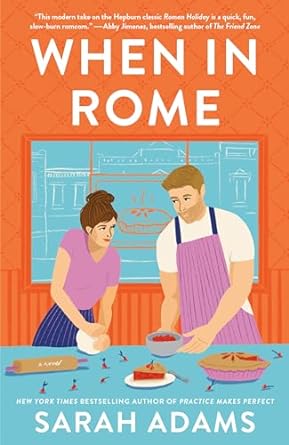
When in Rome

The first one I picked up was a gift from my sister-in-law for Christmas. Boy, does she *get* me. This charming rom-com, “When in Rome” by Sarah Adams, featured a stressed-out pop singer (think Taylor Swift) who was hooked on Audrey Hepburn movies, especially Roman Holiday. When Audrey’s character had too much to cope with, she escaped to Rome, Italy. When the lead character in the book, singer Rae Rose took off for the nearest Rome she could find to her home in Nashville – Rome, Georgia. Of course, there she meets the charming and handsome single man, unlucky in love, who is carrying on tradition by running the family pie shop. You can guess it all from there – it’s a delightful combination of Roman Holiday and every Hallmark movie. Plus Rae’s witchy manager who makes her life a torment!
The Guest List

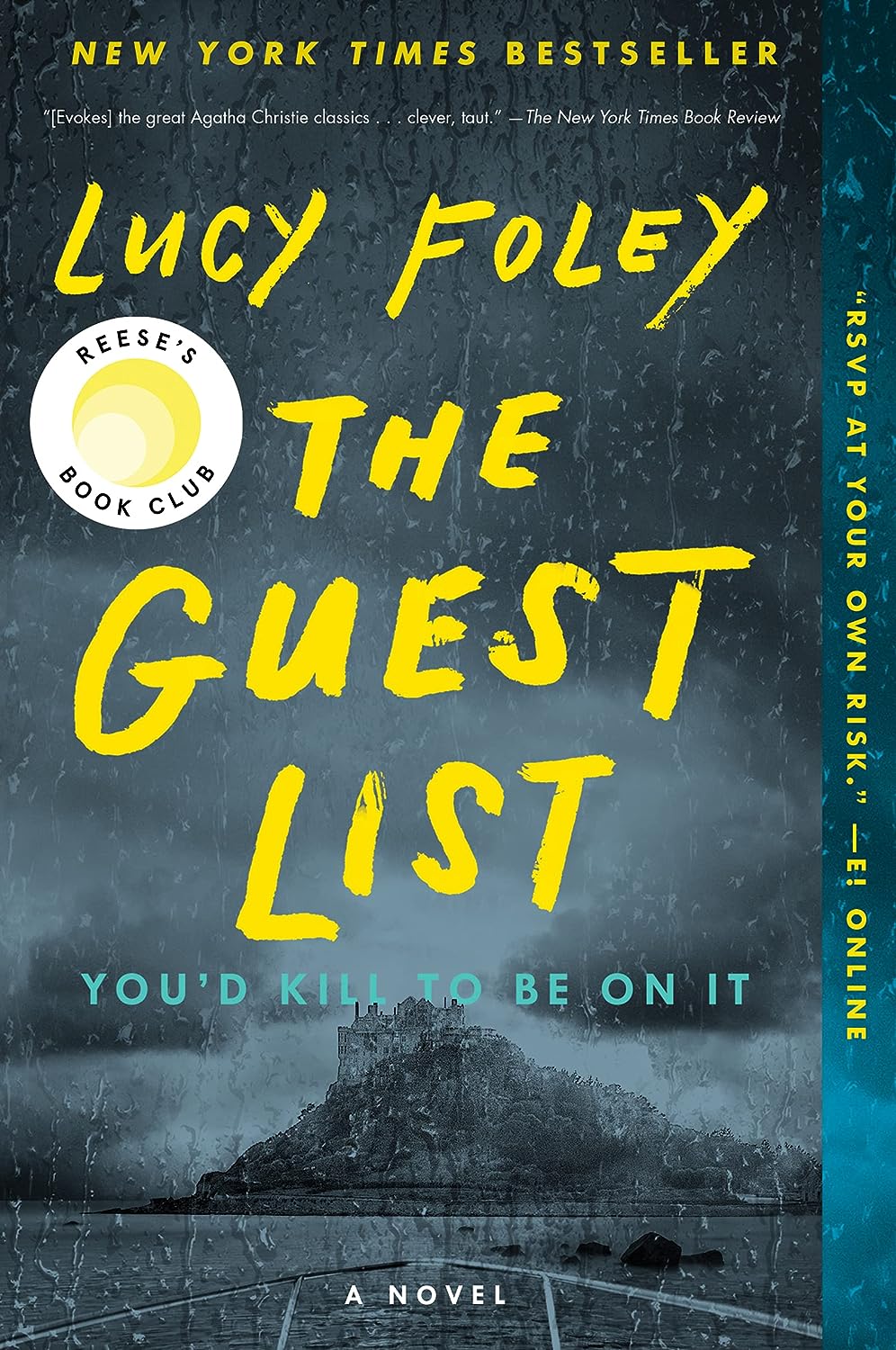
Next up was another gift from my sister-in-law, and again, she did not disappoint. “The Guest List” by Lucy Foley was a Reese’s Book Club pick as well as a New York Times bestseller. This mystery keeps you guessing until the last chapter – the person you think will be killed isn’t. And the person you think did it, didn’t. Set on an island off the coast of Ireland, the scene is a celebrity destination wedding. The bridesmaid, the plus-one, the best man, and the wedding planner all have secrets. And the bride and groom both have character flaws that are slowly revealed through the story. This is a fascinating thriller in the style of Agatha Christie.

Sex and Vanity: A Novel

Lastly, I read a book that wasn’t nearly as trashy as the title makes it sound: “Sex and Vanity: A Novel” by Kevin Kwan, the author of the Crazy Rich Asians trilogy. This one starts with a wedding also – but this time on the fashionable island of Capri. Half the fun is the description of the lavish, over-the-top, week-long wedding celebration of a high-society couple. All the parties, bridal shower, special concert and pre-wedding activities are lovingly detailed, as well as the wedding itself. Kwan grew up in the rich Singaporean society he wrote about in his Crazy Rich series, so he speaks from authority when he addresses the clothes, hobbies, and preoccupations of the one percent. One amusing aspect: when each character is introduced in the narrative, Kwan gives the person’s educational background, starting with exclusive primary school and private secondary school, then on to top league college and grad school. It’s a fluffy look at how the creme de la creme live, play, and spend the money. And of course, there’s a happy ending. It’s like indulging in a delightful chocolate bon bon!

Books

Let’s read others’ body language

Consider these situations: A CEO is across the table from negotiating with a peer for the best terms in a merger. A mother is questioning her teenage son about where he was the night before. An HR rep is interviewing a new prospect.

Every one of these people wants to know what the other person is thinking.

They’d have no problems if they read Joe Navarro’s “What Every Body Is Saying: An Ex-FBI Agent’s Guide to Speed-Reading People.” This book not only shows you how to read the clues when someone is being dishonest, but it also teaches how to maintain situational awareness, and maybe even win a poker game or two.

The limbic brain in action

Navarro and his co-author begin with an explanation of the brain, and how our most primitive brain – the limbic brain – is responsible for most of our body language. We’re responding to situations with the most basic of impulses without thinking: freeze, flight, or fight.

This book is filled with examples of body cues Navarro learned from his 25-year career in the FBI. These memorable vignettes are liberally placed through the book, and along with numerous photos demonstrating each body position, help break up the text chock full of citations. Some of the scenarios are ones you can practice immediately.

And – the one area of the body which is the most “honest” part? The part of the body that cannot but help but give you away if you are lying? It’s not your face. A trained poker player can master their face. No, the answer will surprise you. And I’m not giving it away here – go get the book

Books

An Attack on Us

Is it possible the United States could face the same kind of danger here at home that many countries have experienced? What if Israel’s 10/7 happened here? Most importantly, is that plausible?

Kurt Schlichter thinks so. This author, attorney and commentator released a short novel on Jan. 8 that says yes, it could happen here, all too easily. “The Attack” takes the current national security weak points that everyone knows about and yet no one does anything about, the porous border and an ineffectual government response, and draws the tale out to a logical conclusion. If there is no real border, and thousands of undocumented, unverified, *unvetted* people are moving across each day, hundreds of jihadi could be slowly positioning themselves for an attack. With one phone call they could be activated to strike at once. As Kurt points out in his novel, it’s quite an enhancement when the leaders don’t have to do any command. Jihadis eager to kill as many and welcoming death will cause significant chaos without any fancy plans or leadership.

The novel suggests an event that spreads to touch nearly all Americans. During 9/11, most of the country was untouched physically. Imagine an attack designed to be so vast that no one section of the country could look on in horror, and reassure themselves, that kind of thing happens only in New York or Washington. I remember during 9/11 reassuring my roommate that terrorists weren’t coming to our small town – and being fairly certain I was right. In the novel, one statistician estimated that 84% of Americans knew someone personally who had been killed. Ninety-eight (98)% knew someone who knew someone who was killed. That impact is the kind which remakes country.

Kurt wrote “The Attack” in just three short months after the October 7 attack in Israel. The man is known for turning out a novel each year in his Kelly Turnbull series, on top of his regular day job, but this is impressive even for him. A publishing house approached him about doing a non-fiction work, but another friend persuaded him to turn it into fiction.

The story takes the form of an oral history, with “The Author” interviewing witnesses and participants in the attack five years later. Kurt structures the interviews into before, during each of the three days of the attack, and after. Each story is a short chapter. The “interviewees” range from those cartel members who facilitated the transfer of jihadis and weapons, housewives and mothers who survived attacks on their families, orphans who saw their families killed in front of them, to historians cataloguing the events. It is hard to read, but the story is so fascinating you are compelled to read on.

And it is all too possible. Pray that such an event never happens here.

Books · Christmas · Family · Gratitude

The beautiful books of Christmas 2023

Friends and family showered me with books

Every Christmas – what do you do after the last present has been unwrapped, ooohed and ahhhed over, and the ribbons and paper tossed aside? I don’t know about you, but I grab another cup of coffee and sit down with my new books. And this year was a doozy! Some came from my Amazon wish list, and some came from the stellar gift-giving skills of my friends and family. Here, let me show you:

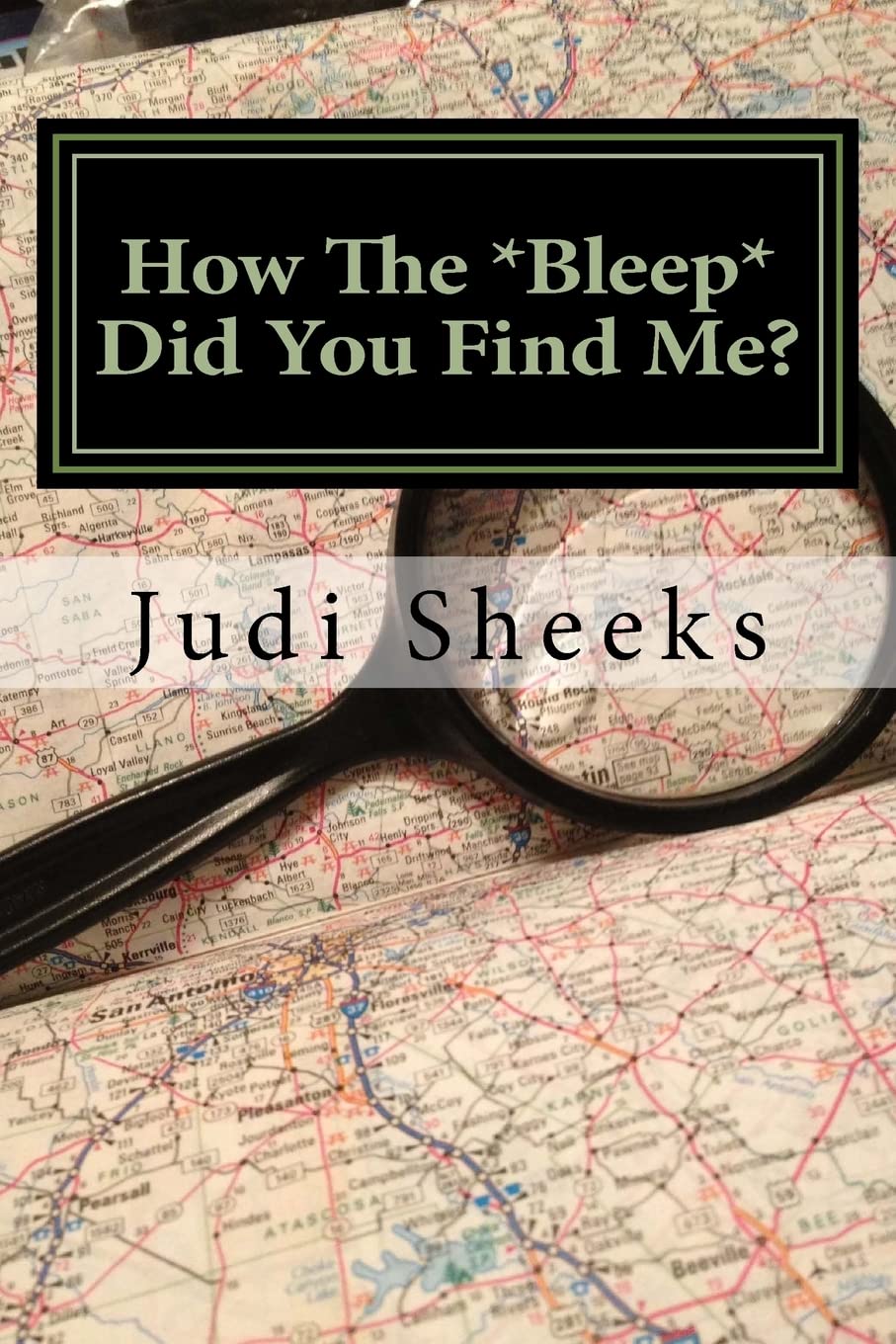
The first one I read through in just an hour or two – it’s a speedy read at only 108 pages. How the *Bleep* Did You Find Me? is skiptracer Judi Sheek’s story of her 30 years in the skiptracing, or “bounty-hunting” business, as I call it. She actually had one subject ask her the question that became the book’s title point blank. It’s the perfect collection of stories about how we leave evidence of our lives EVERYWHERE. Of course, you think – we have digital footprints all over! But people were doing skiptracing long before the internet. She can find practically any document you’ve ever signed. If you have a utility bill, then you can be found. I loved this book. After reading it I immediately checked to make sure all my social media settings were “private.”

Next, I tore through a commemorative magazine on The Coronation of Queen Elizabeth II. Mom knows I’m fascinated by the British royals – all those pretty gowns! The jewels! The tiaras and crowns! – so she made sure I had this copy. It even covered the 2023 coronation of King Charles III.

Art and Wisdom

Next were three beautiful books that arrived before Christmas, from my sweet friend Jill. First one I read was Rooms of Their Own: Where Great Writers Write. She knows I’m working on a story of my own, and I was thrilled to see the different spaces famous writers had created for themselves. Some were pristine, set with windows looking over beautiful views, and others were as messy as mine. Jane Austen made do with a tiny 12-sided table in the family parlor. The book is illustrated with glorious watercolors of the spaces, and some vintage photographs.

Next up is Bedside Companion for Book Lovers: An Anthology of Literary Delights for Every Night of the Year. I’ve read just one item in it, for the day I received the book. Then, I decided to keep it by my bedside for 2024. Each page is numbered by the day of the year – January 1, January 2, and so forth. The night’s selection might be a poem, single paragraph, or a full page. I can’t wait to delve into it each night before bed, last thing before I go to sleep. With this gift I moved the floor lamp behind my bed to function as a reading light.

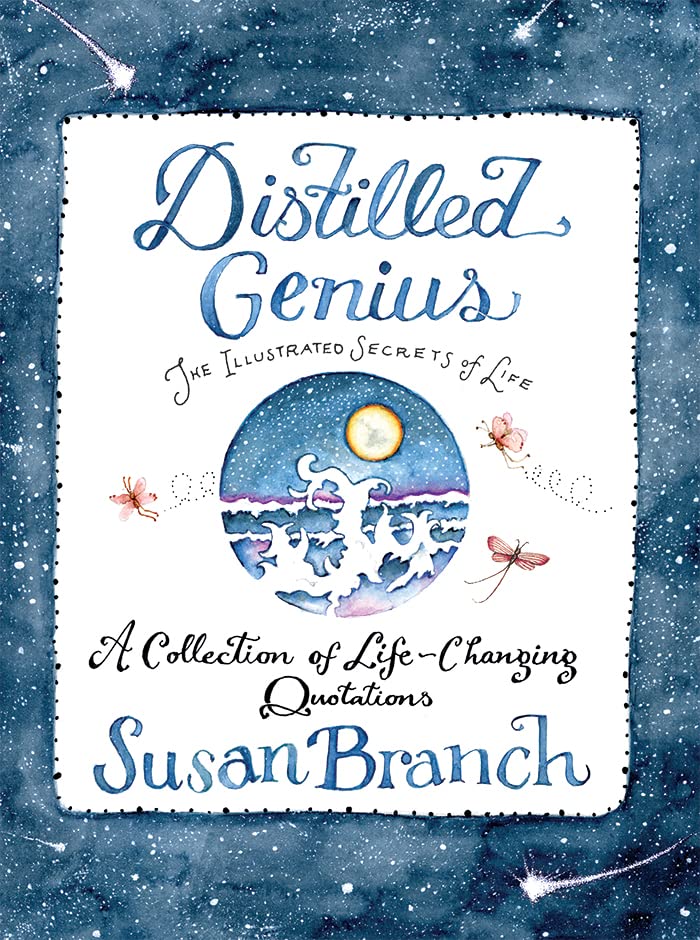
Jill gave me also a new book from a favorite artist and author – Susan Branch. Her Distilled Genius – A Collection of Life-Changing Quotes is enough to fill three commonplace books. Each page is hand-painted – both text and illustrations – by this wonderful artist. Because of her work I’ve added Martha’s Vineyard, her island home, to my bucket list of places I must visit.

Romance, Thrills, and Horror

When I looked at my Christmas gift from “the Rust gang” – my brother Bill’s family – then I knew I was in for a treat. Sister-in-law Reisha wrapped everything in a bibliophile-friendly book tote, with the covers of famous classics on the front. In addition to many other gifts (stationery AND stamps! An embosser to put my seal on all my books!) I received three books I’ve moved to the top of my must-read pile.

I’ve already started Neal Shusterman’s Unwind and it is living up to the word ‘dystopian.’ A group of teenagers is on the run in a post-war America; an America that fought a civil war over abortion. The two sides signed a treaty that outlawed abortion; but made it possible for parents and the state to “unwind” teens from 13 to 17. It’s a basically organ donation of – everything! And society tells itself that the teen isn’t technically being killed – they keep living in a “divided” state. Now that I type that I realize how ridiculous it is. But I want to find out what happens to these three, so I’m gonna keep on reading!

The two that I haven’t started are When in Rome by Sarah Adams and The Guest List by Lucy Foley. I will probably read “When in Rome” first – it looks like a cheerful romance. Per the cover blurb: “This modern take on the Hepburn classic Roman Holiday is a quick, fun, slow-burn romance.” Sounds wonderful! And then I get to enjoy a Reese’s Book Club selection, “The Guest List.” From the back cover:

An exclusive wedding on a remote Irish island. The bride. The plus-one. The best man. The wedding planner. The bridesmaid. All have a secret. All have a motive. But only one is a murderer.

Yes, please! I’m so excited to have a few days off for the holiday. Lots of time to read!

Books

Book Review: A mother’s hope

Beyond tears, indeed

Today I finished “Beyond Tears: A Mother’s Fight to Save Her Son in Nazi Germany.” Earlier I’d written about how tough it was to read the book, with its vivid descriptions of the tortures Hans Litten had to endure, and the pain his mother went through to even visit. As I continued, though, the spirit of Hans and his mother shone through the suffering. There were many testimonies of his, and her indomitable spirit.

Background

Hans was born to a comfortable, upper-class family in 1903. His father was a monied law professor of good family, his heroic mother a daughter of a long line of pastors. In the depression after the first World War, the family lost their money and Hans, a brilliant student, turned to law studies as a practical career instead of being a scholar. He had a passion for justice and truth. He set up his own practice to defend workers.

Hans came to the attention of not only the Nazis, but Hitler himself early. In 1931, he subpoenaed and questioned Hitler himself on the stand during a case involving Nazi thugs killing three workers on New Year’s Eve. His relentless questioning, forcing Hitler to defend his party, marked him as an enemy of the Fuhrer. Friends urged him to leave Germany, but he simply said: “The millions of workers can’t get out,” he said. “So I must stay here as well.” Immediately after the Reichstag Fire in 1933, Hitler gave orders that Hans was to be taken as a political prisoner, without trial. So began a five-year stay in a succession of prisons and concentration camps – Sonnenburg, Esterwegen, Lichtenburg, Buchenwald, and finally Dachau.

Inspiring others

Throughout the five years of imprisonment, Hans used his brilliance and his care for those who had less made him a comfort to many of his fellow prisoners. After he was assigned to a Jewish prison group, which was given harsher punishment of isolation periods, he’d teach the others literature and philosophy – from the works he had memorized. Fellow prisoners who were pardoned and let out would visit Frau Litten and tell her of how those times in isolation – meant to be a punishment – were some of the most rewarding. When he was allowed parcels from home in the early days, he’d ask for the maximum amount his mother could send – so that he could split them with other prisoners.

…a nation which shivers with dread, a nation degraded to the level of a horde of cowardly slaves or brutish criminals, which has lost all sense of human dignity, all sense of right and wrong, will be incapable of rising in its wrath against a government of bestial gangsters.

– Beyond Tears: A Mother’s Fight to Save Her Son from Nazi Germany

Frau Litten’s courage

The book, written by Frau Litten and published in 1940, is mainly her story. She describes how she went to almost any length in her fight to save her son. She soon learned to shout “Heil Hitler” at any Gestapo officer she was forced to meet, in order to secure quarterly visiting passes. She learned to lie, marveling at her ease in doing so. Working with sympathetic Englishmen and others, she kept pressure on the German government from abroad. She found that some Germans who sold her gifts for her son (when she could send them) wouldn’t accept her money when they heard who was to receive the present. Sadly, she also found that many didn’t want to help, out of fear. She fought against a community “degraded to the level of a horde of slaves… which has lost all sense of human dignity, all sense of right and wrong….”

As I knew from the beginning, the story of Hans ends tragically. Five years of suffering, of maltreatment, beatings, broken bones that were never treated, and unimaginable torment caused Hans to take his own life in February 1938. His mother fought continuously to save him. At the end, she succeeded in giving him a dignified, simple funeral service, the kind Hans would have wanted. And she succeeded in having no Gestapo guards from the camp present at that farewell.

Remembered today

. Over the years, the name of Hans Litten fell between the cracks of history – he defended Communists, so the US wasn’t eager to make a hero of him during the cold war, and since he turned against the young Communist party in Germany, the Soviets didn’t claim him either. Another book, published in 2008, “Crossing Hitler: the Man Who Put the Nazis on the Witness Stand” publicized his life, and led to a BBC drama and documentary. In reunified Berlin, the legal association is named in honor of Hans Litten.

Books

Book Review: In the Valley of Achor

Patricia Gaddis Brannon’s journey

As a book lover and compulsive reader, I’ve often wondered what life would be like if I went blind. What if I couldn’t read? It’s one of my favorite things to do in the world. In seventh grade, when at my first school eye exam I was told I was very nearsighted in one eye (an undetected lazy eye) I thought about it for the first time. With “be prepared” as a personal motto, I thought to myself, “I will learn braille.” Problem solved, I went on my happy way.

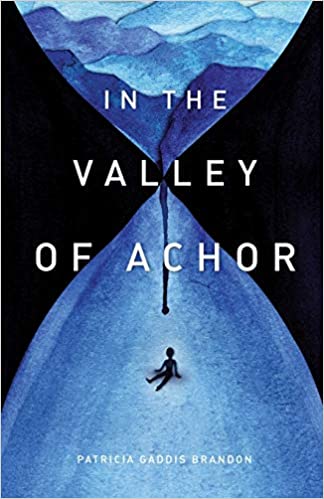
But what if you couldn’t walk? Patricia Gaddis Brannon had to face this question without any mental preparation. One morning, she got up, and within minutes was sitting on her floor, her legs paralyzed in front of her. Her book, “In the Valley of Achor” covers the first year of her journey after the extremely rare paralysis which took her mobility. One day she felt a little twinge in her back when she lifted her garage door, but it was so temporary she didn’t think of again. The next morning, June 28, 2014, she was up early to finish many errands before she left on her first trip to Europe. She was barely able to walk back to her bedroom before succumbing to a “falling sensation” and eased herself down to the floor by the footboard of the bed, unable to move her legs.

The doctors at first diagnosed her with transverse myelitis, an inflammatory disorder of the spinal cord. Doctors at Johns Hopkins later changed the diagnosis to vascular myelopathy, a mechanical malfunction of the spinal cord blood system. Her spinal cord had suffered a “mini stroke” in effect. But the doctors at Johns Hopkins left her with the news that though they didn’t know if she would walk again, they did not find any reason why one day she might not. Her job was to work hard at physical therapy and never give up.

“Do not fear; just believe.”

Patricia heads each chapter describing her journey with an appropriate Bible verse, showing how she leaned on her faith in Christ to see her through the struggle. Her memoir’s title comes from the Biblical book of Joshua, in the story of a disobedient Israelite who was stoned in the Valley of Achor – a Hebrew word meaning trouble. But the book of Hosea, God transforms that place of sadness for the Israelites: “There I will give her back her vineyards and make the Valley of Achor a door of hope.”

The author looks at every part of the story honestly, not sparing her feelings, and sharing with us the times she “melted down” in tears, angry and frustrated. She is no plaster saint, but a real woman placed in impossible-to-believe situation. One day she is playing tennis, coming back from active trips to the mountains and beach, driving her beloved red convertible: the next, in a wheelchair.

“I’m not going to take that sitting down!”

But Patricia doesn’t wallow. She’s too full of joie-de-vivre to do that. Two of the chapters are titled “A Comic Interlude” and prove that she nearly always saw the funny side of the situation. “‘I’m not going to take that sitting down!’ becomes a much more acceptable response, when spoken by one in a wheelchair.” and “‘Don’t worry, I brought my own chair’ is a great party-starter when in a wheelchair at a crowded restaurant table.” Her life motto is “If you ain’t living on the edge, then you ain’t got a view!” and it shines forth in these pages.

I’m blessed to have met Patricia in person: she now goes to the church I attend in Columbia. She is still in a wheelchair, but she still is doing physical therapy and has never given up hope of a full recovery. And with her many friends and activities, she’s still living on the edge, enjoying one heck of a view.

Books

“The Magician’s Nephew”

Revisiting a beloved book

When my book club chose “The Magician’s Nephew” by C.S. Lewis for our next book, I was unsure. How were we adults supposed to enjoy this book, and stretch discussion out over several weeks? Isn’t the book for children?

It may have been written for children, but the book has so much to offer on second reading as an adult. Our first meeting (which I had to miss due to a cold) was devoted to talking about just chapters 1 and 2. In them we meet the children at the heart of the story: Polly and Digory, and Digory’s wretched Uncle Andrew, who entices them into a magical land far away. In those first two chapters Lewis builds out the characters of each child, and Uncle Andrew with careful descriptions. The children are written as children, who after meeting each other find an empty attic to explore, with a long corridor over their attached rowhouses. Lewis writes their daring and egging each other on to explore as anyone who remembers their tweens would:

“Shall we go and try it now?” said Digory.

“All right,” said Polly.

“Don’t if you’d rather not,” said Digory.

“I’m game if you are.” said she.

Uncle Andrew thinks so highly of himself he tells Digory:

“Men like me, who possess hidden wisdom, are freed from common rules just as we are cut off from common pleasures. Ours, my boy, is a high and lonely destiny.”

…while Diggory shows his native 12-year-old smarts as he “saw through Uncle Andrew’s grand words:”

“All it means, he said to himself, is that he thinks he can do anything he likes to get anything he wants.”

Lewis closes each chapter with a cliffhanger designed to keep even his youngest reader following the story. At the end of Chapter One Polly vanishes; at end of Chapter Two, Diggory follows. And the pattern continues; at the end of one, Lewis ends with the characters thinking the trouble was over, “but they had never been more mistaken in their lives.” The depictions of the different worlds are so rich that it was easy for illustrator Pauline Baynes to create the beautiful artwork in the book (2001 HarperCollins edition.) The descriptions are not only visual; you can almost hear the songs that created Narnia as you read the chapter “The Founding of Narnia.” And to find what becomes of Uncle Andrew – that is a delight!

Aslan with Lucy and Susan from The Lion, the Witch, and the Wardrobe, illustrated by Pauline Baynes

If I had one quibble with this book it is the description of Aslan. The description isn’t as rich, or full, as the careful description that Lewis gives Aslan in “The Lion, the Witch, and the Wardrobe.” It makes sense that Lewis would describe Aslan more fully in the that book – since it was the first time he’d written about Aslan. To me, that is an indicator that the reader should start with “The Lion, the Witch, and the Wardrobe,” then read all the other books in the publication order. No matter that Lewis himself said that he preferred the chronological order, which makes this Book 1 in the series. I’ll always prefer the introduction to this wonderful world in that first published book.

Books · educational · Family · Introspection · politics

Gird Your Loins and Fight

Latest in my series of book reviews

Never go to war against a mom

Before I started “weaning” myself off my smartphone – I couldn’t have handled a 651-page book – even one as entertaining as “Shut Up! The Bizarre War that One Public Library Waged Against the First Amendment.

The librarian of your nightmares wants you to stop questioning the Library Board

This book makes me so glad I did the work to get my concentration back. Authors Megan Fox and Kevin DuJan tell the tale of their multi-year fight with a public library which allowed adults to access porn on their computers – and did nothing to stop it, saying it was allowed by the First Amendment. (Spoiler alert: no, the Supreme Court ruled libraries do NOT have to allow access to porn.)

A pleasant day turned peep show

At the beginning of the saga, Megan was a homeschooling mama of two little girls, named “Seven” and “Four” to protect them in the book. One day she decided to take them to the Orland Park Public Library with friend Kevin along with the ride. A quick errand to print some homeschool activity sheets led to a three-year saga – complete with lawsuits and a cast of characters that could fill a long-running soap opera. Here’s how Megan described it:

“There’s the awkward sibling of a beloved TV icon; a national hero from the Reagan administration; a former Playboy model, jewel thief, ex-wife of a Chicago Bear, ex-girlfriend of an infamous mobster who turned state’s evidence against him (and those last four are all the same person!); Our Ladies of the Perpetually Furrowed Brows; the heiress to the Comiskey baseball diamonds; a former United States Senate candidate from Illinois (who is more famous for once being married toa Sci-Fi starlet who flew around the universe in a spaceship); the King of Journalism; a gargoyle; someone who sold his soul on eBay (like it was a good thing); hot cops; … some of the best lawyers in the whole damn world (pitted against clearly some of the worst) … SNL’s Weekend Update; … the Karate Kid; famous legal scholars; fearless watchdogs; sexually harassed whistleblowers; and the nation’s leading expert on the dangers to children in public libraries.”

-Megan Fox

Truly, this book had EVERYTHING, as Megan described it: “Sex, government corruption, child porn, a gold heist, libel, slander, defamation, lawsuits, death and rape threats, police harassment, a SLAPP, cloak and dagger intrigue, fruits, 7 pounds of Italian beef and 2 large jugs of peppers, and special interest groups out to sabotage a suburban mom and her whimsical gay friend.”

Kevin and Megan take turns, chapter by chapter, telling the story. Their styles of storytelling complement and contrast with each other. Both bring in themes from children’s stories to anchor the tale: if you’ve read Harry Potter you’ll love the way they work in references to that saga. Kevin’s style is more “whimsical” as Megan said, and Megan’s motherly concern doesn’t just shine through – she’s on the warpath to make the library safe for all kids. Thank God these two are people who NEVER back down. They fought a public governmental body for years and triumphed. The best stories are ones where good defeats evil – and that’s exactly what happens here.

Whew!

At the end, you, the reader are drawing in a long breath after just reading about it. By the time the final lawsuit was settled, Megan had added another baby to her family. Kevin was advising other libraries how to prevent these horrors from happening.

I wanted another book – a sequel. What new adventure did Kevin and Megan have? What crimes are they uncovering? Today, you can follow Megan’s investigative reporting on PJ Media and on her YouTube channel. I haven’t been successful finding Kevin’s public profile (but then, I don’t use Facebook anymore!) I’m sure wherever he is, he’s busy employing his talents of organization, letter-writing and campaigning to keep fighting for government accountability.