Books · religion

Our Pain Matters to God

A review of Where is God in all the Suffering?

I began this book immediately after last week’s book, What if It’s True? The author. Amy Orr-Ewing, is an Oxford-educated, a writer, and director of an apologetics center. While she is a passionate layperson devoted to evangelism, she does not have the novelist’s eyes that Charles Martin has.

That made getting into this slim volume (130 pages) a little more challenging for me. The best parts of the book are where she relates her own experiences, or the experiences of others very close to her, in suffering. Her depiction of the Grenfell Tower fire opens the chapter on Anger. Anyone who keeps up with the international news remembers that – but many don’t know about the events in the week after – the service that she and her husband conducted for the survivors and community after. That moving story showcases God’s love for all those angry and in pain in that tragedy.
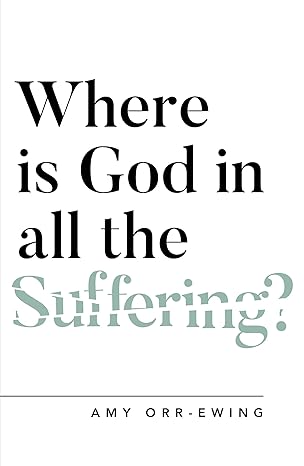
With these scenes from her life Orr-Ewing begins the chapters of this book. Each chapter focuses on a particular emotion or type of suffering: grief, sickness, natural disasters, violence, and more. In each chapter, after the opening, she looks at how Christians perceive God’s response. Where is He? She continually contrasts the materialist/atheist philosophy against what Christians believe. In the chapter on sickness, she writes:

But why should the physical frailty of our bodies hurt us at this almost transcendent level? Could our human experience of illness be a reminder, an indicator, that to be human is to be more than a material entity of molecules and atoms?

She reminds us that Hebrew poets from 3,000 years ago were asking God about this in words that Christians and Jews cherish today:

Hear my prayer, Lord;
let my cry for help come to you.
Do not hide your face from me
when I am in distress.

Psalm 102: 1-2a

The Psalmist continues with vivid depictions of his illness:

My heart is blighted and withered like grass;
I forget to eat my food.
In my distress I groan aloud
and am reduced to skin and bones.

Psalm 102: 4-5

This second book in my Lenten reading series made me realize anew the power of story to convey truth. A story captures our imaginations and brings us in. A listener or reader empathizes with the characters, perhaps cheering them on or watching in despair. Stories are what we remember – not lectures. After all, did not the greatest teacher ever known teach in parables?

Books

Book Review: A mother’s hope

Beyond tears, indeed

Today I finished “Beyond Tears: A Mother’s Fight to Save Her Son in Nazi Germany.” Earlier I’d written about how tough it was to read the book, with its vivid descriptions of the tortures Hans Litten had to endure, and the pain his mother went through to even visit. As I continued, though, the spirit of Hans and his mother shone through the suffering. There were many testimonies of his, and her indomitable spirit.

Background

Hans was born to a comfortable, upper-class family in 1903. His father was a monied law professor of good family, his heroic mother a daughter of a long line of pastors. In the depression after the first World War, the family lost their money and Hans, a brilliant student, turned to law studies as a practical career instead of being a scholar. He had a passion for justice and truth. He set up his own practice to defend workers.

Hans came to the attention of not only the Nazis, but Hitler himself early. In 1931, he subpoenaed and questioned Hitler himself on the stand during a case involving Nazi thugs killing three workers on New Year’s Eve. His relentless questioning, forcing Hitler to defend his party, marked him as an enemy of the Fuhrer. Friends urged him to leave Germany, but he simply said: “The millions of workers can’t get out,” he said. “So I must stay here as well.” Immediately after the Reichstag Fire in 1933, Hitler gave orders that Hans was to be taken as a political prisoner, without trial. So began a five-year stay in a succession of prisons and concentration camps – Sonnenburg, Esterwegen, Lichtenburg, Buchenwald, and finally Dachau.

Inspiring others

Throughout the five years of imprisonment, Hans used his brilliance and his care for those who had less made him a comfort to many of his fellow prisoners. After he was assigned to a Jewish prison group, which was given harsher punishment of isolation periods, he’d teach the others literature and philosophy – from the works he had memorized. Fellow prisoners who were pardoned and let out would visit Frau Litten and tell her of how those times in isolation – meant to be a punishment – were some of the most rewarding. When he was allowed parcels from home in the early days, he’d ask for the maximum amount his mother could send – so that he could split them with other prisoners.

…a nation which shivers with dread, a nation degraded to the level of a horde of cowardly slaves or brutish criminals, which has lost all sense of human dignity, all sense of right and wrong, will be incapable of rising in its wrath against a government of bestial gangsters.

– Beyond Tears: A Mother’s Fight to Save Her Son from Nazi Germany

Frau Litten’s courage

The book, written by Frau Litten and published in 1940, is mainly her story. She describes how she went to almost any length in her fight to save her son. She soon learned to shout “Heil Hitler” at any Gestapo officer she was forced to meet, in order to secure quarterly visiting passes. She learned to lie, marveling at her ease in doing so. Working with sympathetic Englishmen and others, she kept pressure on the German government from abroad. She found that some Germans who sold her gifts for her son (when she could send them) wouldn’t accept her money when they heard who was to receive the present. Sadly, she also found that many didn’t want to help, out of fear. She fought against a community “degraded to the level of a horde of slaves… which has lost all sense of human dignity, all sense of right and wrong….”

As I knew from the beginning, the story of Hans ends tragically. Five years of suffering, of maltreatment, beatings, broken bones that were never treated, and unimaginable torment caused Hans to take his own life in February 1938. His mother fought continuously to save him. At the end, she succeeded in giving him a dignified, simple funeral service, the kind Hans would have wanted. And she succeeded in having no Gestapo guards from the camp present at that farewell.

Remembered today

. Over the years, the name of Hans Litten fell between the cracks of history – he defended Communists, so the US wasn’t eager to make a hero of him during the cold war, and since he turned against the young Communist party in Germany, the Soviets didn’t claim him either. Another book, published in 2008, “Crossing Hitler: the Man Who Put the Nazis on the Witness Stand” publicized his life, and led to a BBC drama and documentary. In reunified Berlin, the legal association is named in honor of Hans Litten.